AI is commoditizing technical execution. Without us realizing it, the value of a professional who only knows how to receive requirements and execute an operational task —who I call the "pica-teclas"— is decreasing daily. AI performs very well in all operational aspects. If a person dedicates zero mental effort to a repetitive and specific task, they run the risk of becoming a commodity.
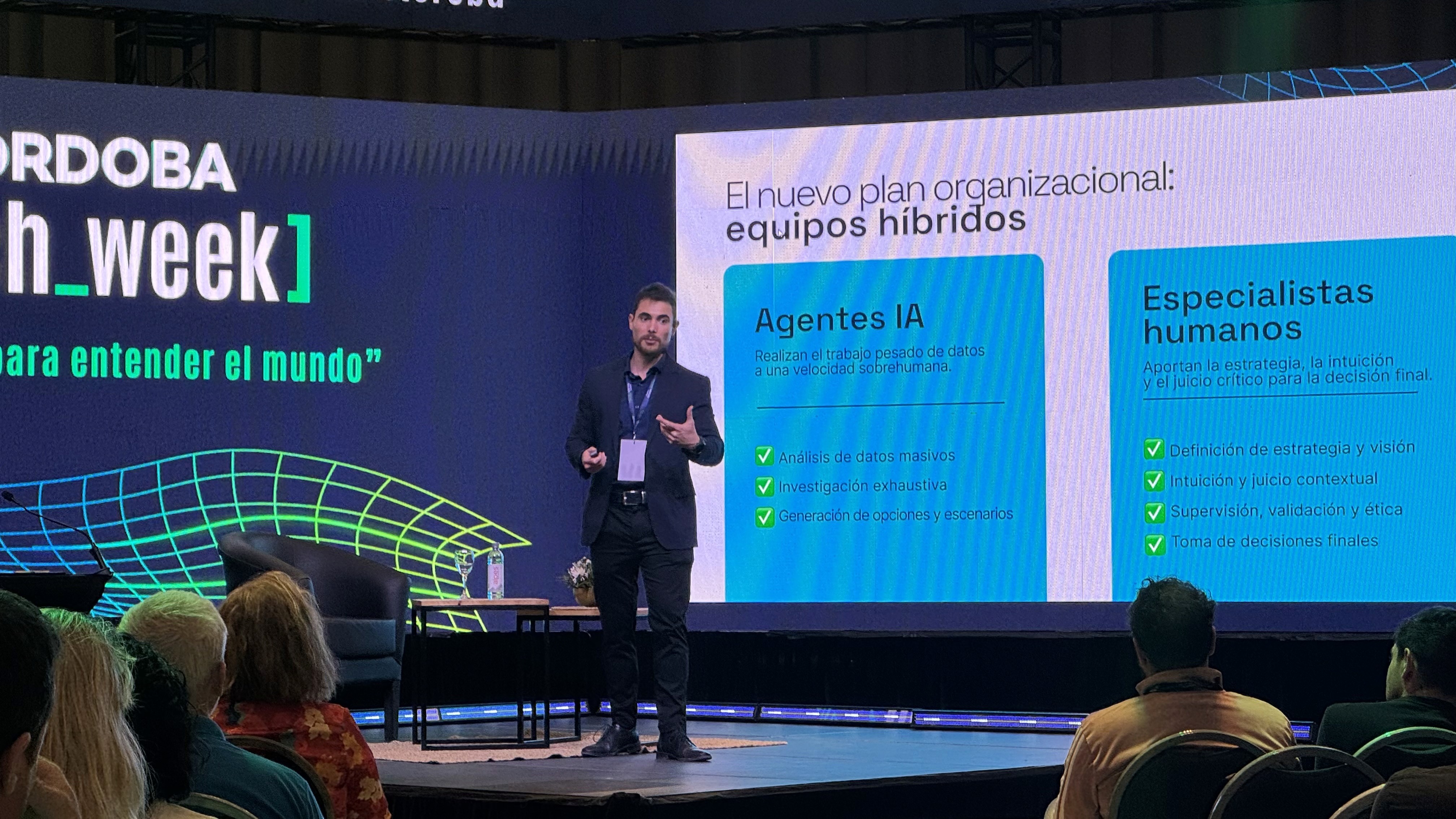
The advancement of Artificial Intelligence (AI) does not only threaten the volume of employment, but is driving a more subtle and dangerous phenomenon in the global job market: the "silent depreciation" of professionals. This was stated by Franco Scapin, Data Science specialist and CAIO (Chief Artificial Intelligence Officer) at Rocbird.io. He warned that the gap will deepen over the next ten years, demanding urgent social responsibility from big tech companies.
Franco, you use a harsh concept: the "silent depreciation of people." What are you referring to, and how does this affect the labor market?
The concept is brutally simple: Artificial Intelligence is commoditizing technical execution. Without realizing it, the value of the professional who only knows how to receive requirements and execute an operational task —the one I call the "key-puncher"— is reduced daily. AI does everything operational very well. If a person dedicates zero mental effort to a repetitive and specific task, they run the risk of becoming a commodity.
In other words, the value is no longer in doing, but in thinking
Exactly. The value migrates from operation to orchestration. The new profile is the "Strategist Architect": a qualified professional who uses AI as a tool for super-productivity, but who masters the strategic vision and has the ability to check quality. Programming or writing code is the cheap part now; the expensive part is the holistic vision and critical thinking. Whoever does not reinvent themselves and move from execution to strategy is in serious trouble.
Faced with widespread fear of unemployment, you propose a counterintuitive vision, linked to the Jevons Paradox...
It is the great analogy. The Jevons Paradox shows that making something more efficient (like an engine that consumes less fuel) does not reduce overall consumption, but rather triggers it. If AI reduces the cost of producing cognitive or technical results to almost zero, we will not go to a world of leisure, but of hyper-productivity. Instead of delivering one project, we will deliver ten.
So AI won't leave us without work?
I do not have that certainty, but my interpretation is that we will not go to a world where "work is worth nothing." We will go to a world where doing things costs less, and therefore, the demand for high-value projects and speed of execution will multiply. Work does not disappear; it rises to positions of greater coordination and strategy.
You are optimistic in the long term, but critical of the present. What is the immediate risk we are facing?
The problem is the gap. I am an accelerationist: I believe that technology will lead us to a world of abundance, with energy solutions (nuclear fusion), water solutions (desalination), and perhaps a universal basic income. But that promise is 10 or 15 years away. The risk is that job displacement is happening today. We are in the "10 Turbulent Years," a period where layoffs occur before redistributive abundance arrives. Today, people displaced by AI do not have a plan B; there are not enough resources or support.
Where do you place the responsibility in this process?
In the leaders. Big tech companies and their leaders must have a profound social responsibility. If optimization and displacement occur without income or an accompaniment policy for those people, global social instability is being generated. We need the promises of technology to be fulfilled, and for this transition period not to be so hard on those who are left out.
The development of AGI (Artificial General Intelligence) seems to be the new arms race...
It is the new Manhattan Project: the war between China and the United States. Whoever achieves AGI first will pull ahead technologically in such a way that the rest of the nations will remain at an incomparably inferior level of development.
And how does this impact the rest of the world, countries like Argentina?
The country that wins will become the "gatekeeper of the tap" of computation. Those superhuman capabilities will not be distributed cheerfully; they will be used as a mechanism of control, providing them only to allied countries. Not having access to AI in the future will be the equivalent of being condemned to the Stone Age. If states do not invest in science and technology, our sovereignty and development remain entirely subject to whoever wins that war. Today, the priority must be geopolitical positioning and local investment.


