The AI hype is driving the massive use of unsupervised code, generating operational risks and critical technical debt. In this context, architecture, clean code, and human judgment become essential to sustain complex systems.
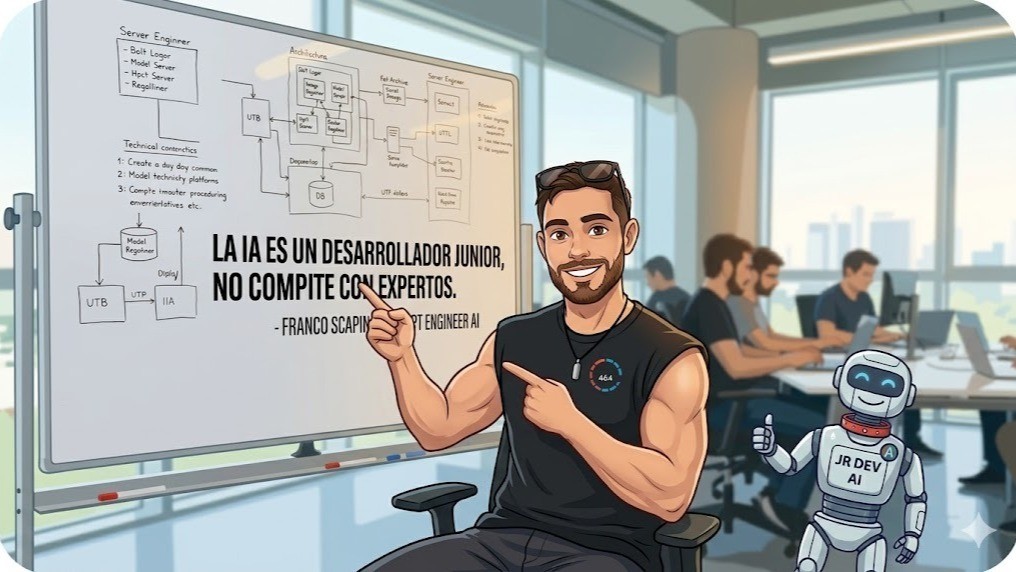
While boardrooms intoxicate themselves with a euphoria of absolute efficiency, the reality in the software engineering trenches is different. We are facing the "Great Mirage": the belief that AI-generated code is the end of developers, when in reality it is a "thousand-horsepower autocomplete" that, without supervision, threatens to bury the integrity of global systems.
The disconnect is tangible. Recently, the market rewarded firms like Spotify for narratives of total automation, while other giants, like Amazon, had to convene crisis cabinets following critical severity incidents. The common factor in these operational collapses is the deployment of AI-generated code without the supervision of a human agent. Technical debt is no longer a maintenance problem; it is a real liability that the stock market has not yet fully quantified.
The fundamental limitation of Large Language Models (LLMs) is not technical, but existential: AI lacks curiosity. It operates in a vacuum of systemic understanding, executing probabilistic patterns without questioning business premises.
The "context" is not an extensive prompt; it is the sediment of past decisions and product motivations that only reside in the mind of the expert.
We are in the era of Vibe Coding, a superficial trend where code is treated as a disposable detail. This phenomenon generates an industrial-scale context poisoning: code lacking technical excellence is defaced until the system becomes unmanageable. In 2026, clean code and solid architecture are no longer a matter of professional pride but a survival investment. A well-structured system is a GPS for AI; a messy one is a labyrinth that only perpetuates chaos.
It sounds paradoxical, but to master the technology of 2026, one must return to the classics of the 90s and 2000s. DDD and Clean Code have never been more necessary. AI is, in essence, a high-speed junior developer. If it receives a self-documenting system, it is productive; if it receives garbage, it hallucinates.
The modern workflow has evolved toward a cycle of design, machine interviewing, and critical auditing. The engineer no longer just "writes code", but rather models problems and assumes ultimate responsibility for deployment. The Pull Request has ceased to be a mere formality and has become a quality dialogue where the human acts as the guardian of intent.
A developer does not just write syntax, but resolves problems in a sustainable way. The media noise attempts to democratize mediocrity, but technical reality demands a mastery that can only be acquired by understanding the fundamentals.
Programming in 2026 is, fundamentally, the ability to infuse purpose and viability into complexity. The advice for professionals is simple: do not obsess over tools, master the architecture. AI can generate code at astonishing speed, but only a human can ensure that this speed does not end in disaster.


