Agentic systems connected to sensitive data are growing faster than the controls surrounding them. The error does not always have an attacker behind it: sometimes it is an agent that misinterprets, combines incorrect information, and delivers what it should not. Rocshield operates at exactly that moment.
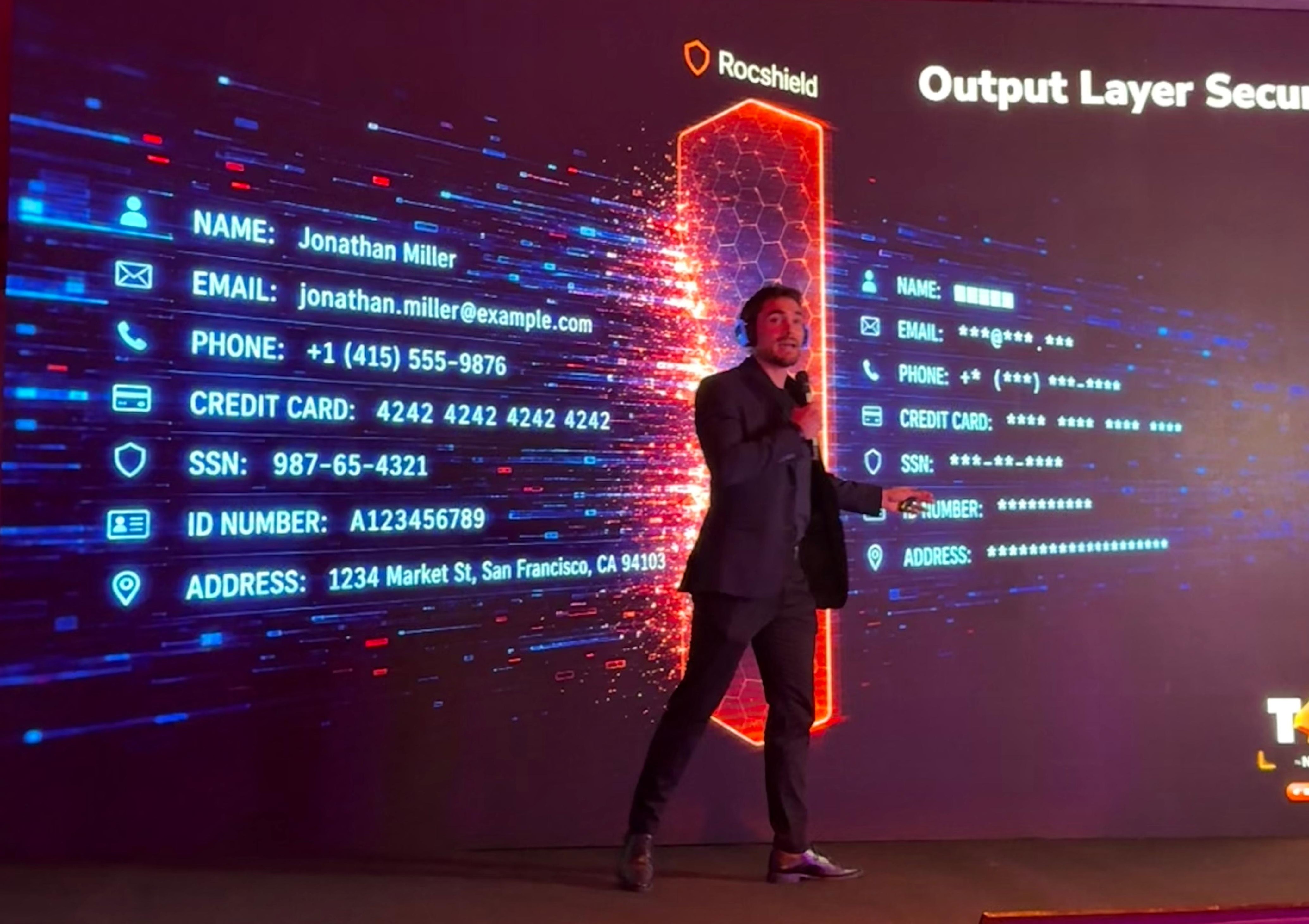
This article is part of the talk “De la promesa al producto: Arquitecturas agénticas que sobreviven al contacto con la realidad” that I gave during the Tech 4 Impact by Naranja X 2026.
There is an exact moment when an agentic solution becomes a problem. It is when the enterprise realizes that information that should have never left has already leaked, and there is no way of knowing for how long.
I saw it firsthand. An agent deployed in production, connected to internal data, exposed confidential information that it should not have exposed. It was not a sophisticated attack. It was a combination of development speed, absence of controls, and the probabilistic nature of a system that, by design, interprets before filtering.
That episode is the starting point of Rocshield.
The problem that the industry ignores until it is too late
The API-first model recommended by the industry today has an impeccable logic: making a company's systems readable for external agents, exposing interfaces that allow interoperability, and preparing for a future where many of the users will not be people but other automated systems.
The problem is what lies behind that openness.
In most cases, behind an API there is an agent. And that agent is a probabilistic system connected directly to the organization's most sensitive data: customer records, contracts, operational history, financial information. Everything that makes a company what it is and not another.
More openness means more attack surface. And a probabilistic layer at the center of that surface is not a defense: it is a vulnerability with a good presentation.
Why distributed controls do not work
The usual response is to delegate security to the developer of each project, letting them implement validations, filter inputs, and restrict what the agent can respond. This is a reasonable solution for one project. It is unviable for ten.
When an enterprise deploys agentic solutions for multiple clients, the question that nobody answers well is this: if a new attack vector appears today, who guarantees that all active solutions remain protected? The honest answer, when security is distributed across each project, is that nobody guarantees it. Someone will remember it. Someone will prioritize it, or not.
Prompt injection attacks are constantly evolving. Writing a keyword with symbols instead of letters can be enough to bypass basic filters. The space of possible variants grows every day, and there is no developer who can keep up with the pace while also delivering features.
Rocshield: a centralized control point
Rocshield was born from that concrete need. It is a semantic security layer that integrates between the user and the agent, operating at two critical moments: input and output.
At the input, Rocshield combines deterministic rules with ontological analysis. Regular expressions and known attack patterns are resolved in milliseconds, without calling any additional model. This is deliberate: adding latency to resolve security is a cost that production solutions cannot afford. For cases that the rules do not cover, the ontological analysis evaluates the intent of the query before it reaches the agent. If it detects a malicious pattern, it silences it. If it identifies an IP with a recurring attack behavior, it blocks it directly.
At the output, Rocshield analyzes the response before it reaches the user. If it contains sensitive information —names, documents, phone numbers, identifiable data— it blocks it. This resolves the most frequent and least discussed scenario: not the intentional attack, but the involuntary error. The agent that searched in the wrong place, hallucinated a piece of data, or combined information incorrectly and delivered something it should not have.
That scenario does not require an attacker. It only requires an agent functioning with imperfection, which is the normal condition of any probabilistic system.
The real value: centralized maintenance
What differentiates Rocshield from implementing controls project by project is not just the architecture. It is the maintenance model.
Each new vulnerability detected, each new attack pattern that appears, is corrected only once in Rocshield and automatically propagates to all solutions using it. A company that deployed ten solutions six months ago does not need to review each one. The protection is updated at the center and distributed outwards.
That changes the economic equation of security. It ceases to be a technical debt that silently accumulates in each project and becomes an asset that improves over time.
Data is the differentiator, not the model
The agent is replaceable. The model it uses is too. What is not easily replicated is the proprietary data that a company built over years. That data is the real competitive differentiator, and it is also exactly what remains exposed when security is not taken seriously from the beginning.
Rocshield starts from that premise: protecting data is not a compliance function. It is a strategic decision. A company that exposes its sensitive information without the proper layers does not just assume a security risk. It hands over its competitive advantage to anyone who knows how to ask the right questions.
The promise of agents connected to real data is valid. But that promise only holds if the surrounding architecture is as serious as the intelligence attributed to the model. Rocshield is the response to that gap.


